
Information Literacy in short, is the ability and willingness to use technology to access and assess different types of media and information.
 |
| Venn diagram showing the IL landscape, and the position of DL within (Secker & Coonan, 2013) Credit: Conference Paper 2016 [Researchgate.net Publication] |
As suggested by the podcast "Fake News and Media Literacy" (accessed HERE), the author of the book "The Information Diet" suggests that our diet of information must be consciously consumed...but that is easier said than done. As we know, especially in light of the recent investigations surrounding the 2016 presidential election, the media that we are exposed to can be manipulated. We come with preexisting belief systems and tend to seek out information that confirms our beliefs. When we do that on a platform such as Facebook or Twitter, the algorithms are built to then feed us a daily diet that matches what we've enjoyed previously.
In order to expand our information literacy and broaden our "diet" we have to expose ourselves to a wider variety of news sources.
The graphic below is a great way to begin to critically assess your news sources to get the broadest range of input from the biggest variety of sources.
As a school librarian, I must use a wide variety of sources to inform my own opinions. Even more importantly, I must teach others to think, choose and read critically to consume the most diverse diet as possible.
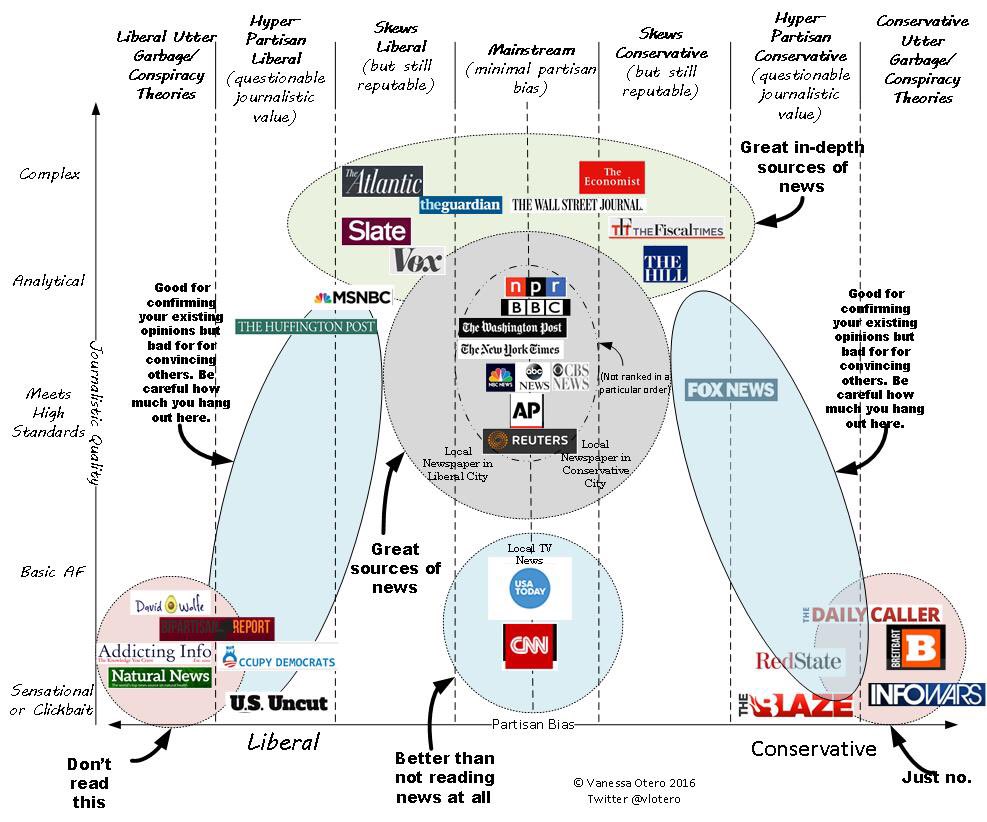
Sources:
Fake News & Media Literacy. (n.d.). Retrieved September 5, 2018, from http://www.theliturgists.com/podcast/2017/3/7/fake-news-media-literacy
Is It Time For You To Go On An 'Information Diet'? (2012, January 14). Retrieved September 6, 2018, from https://www.npr.org/2012/01/14/145101748/is-it-time-for-you-to-go-on-an-information-diet

Clay Johnson in his youtube video "A software toolkit for your information diet." Says "you can't rely on "the media" or the internet to control your information consumption." (Johnson, 2012) He concurs with what podcast "Fake News and Media Literacy" in which we must watch what we consume, what sources we get our information from and how do we use that information. In this video he suggests different software tools to help the consumer track how they receive their daily feed of information. The information-graphic the you used to explain the different types of new sources is great for explaining the different sources to our students and many adults.
ReplyDeleteHis video "The Information Diet': More 'Conscious Consumption' Needed? This video discusses how the consumption of the world's information can actually make us sick.
"A software toolkit for your information diet."
https://www.youtube.com/watch?v=W2Ea3gtbEyI
The Information Diet': More 'Conscious Consumption' Needed?
https://www.youtube.com/watch?v=ljcFNUQF9qQ